Post
Vietnamese Bamboo
May
VIETNAMESE BAMBOO
🎋 There is a Vietnamese saying: “Cây tre vừa đẹp vừa cứng, vừa mềm vừa dẻo” — “The bamboo is beautiful and strong, flexible and resilient.” For thousands of years, bamboo has been more than a plant to Vietnamese people — it is a teacher, a tool, a weapon, and a metaphor for the national character. “Vietnamese Bamboo” celebrates this humble yet extraordinary grass that bends in the storm but never breaks.
Bamboo grows everywhere in Vietnam — from northern mountains to southern deltas, from village gates to riverbanks. Its uses are endless: scaffolding for construction, tools for farming, chopsticks for eating, paper for writing, furniture for homes, instruments for music. During famine, bamboo shoots provided food; during war, bamboo stakes became weapons. The Vietnamese proverb “Tre già, măng mọc” (Bamboo old, bamboo shoots grow) captures the cycle of generations — parents sacrifice, children thrive.
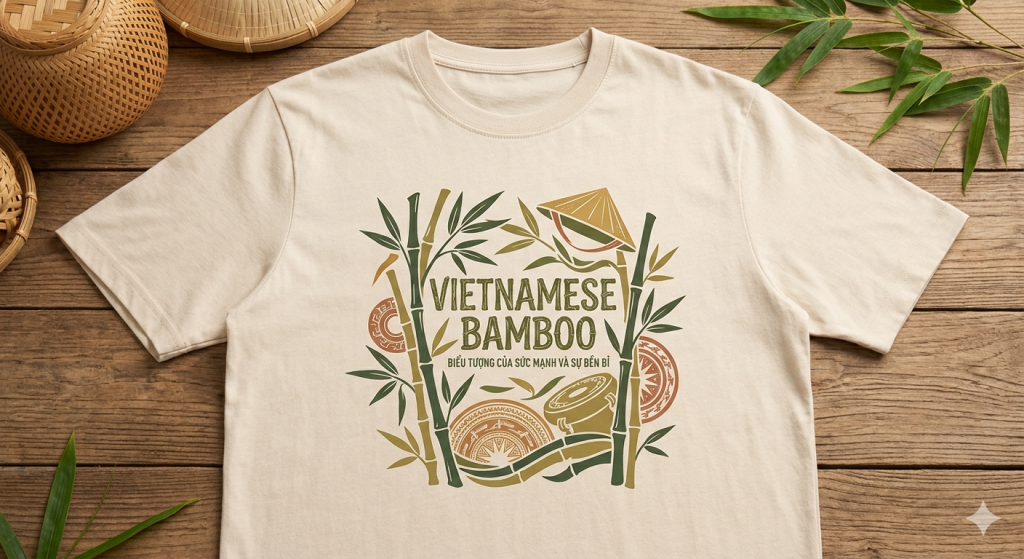
This design incorporates bamboo grove patterns — vertical lines suggesting multiple stalks, cross-hatched nodes representing joint strength, green gradients evoking living forests. The overall effect is organic, natural, and deeply Vietnamese.
The legend of Thánh Gióng (Saint Gióng) is Vietnam’s most beloved folk tale. A miraculous child who remained silent for three years, Gióng suddenly spoke when the nation was invaded, asking for a horse and armor. When he broke his iron sword, he uprooted a bamboo grove and used the stalks to defeat the enemy. After victory, he rode his horse into the sky — becoming an immortal deity.
“Vietnamese Bamboo” incorporates Gióng motifs: upward-moving lines (ascending to heaven), broken sword shapes (adapting to tools at hand), and bamboo-stake patterns (turning ordinary materials into weapons of resistance).
Scaffolding
Giàn giáoChopsticks
Đũa treWeapons
Chông treHomes
Nhà treInstruments
Đàn treDuring Vietnam’s long struggle for independence, bamboo was transformed into a weapon of extraordinary effectiveness. Sharpened bamboo stakes (chông tre) were hidden in pits, under water, and across trails — impeding invaders, slowing tanks, demoralizing soldiers. Bamboo was silent, cheap, and everywhere — the perfect guerrilla weapon. General Võ Nguyên Giáp famously said: “Bamboo is our patriot.”
This design incorporates stake motifs — angled lines suggesting hidden traps, defensive perimeters, and the resourcefulness of a people who turned their environment into a fortress.
In international relations, scholars describe Vietnam’s foreign policy as “bamboo diplomacy” — maintaining relationships with all major powers (US, China, Russia, Japan, India, EU) without becoming rigidly aligned. Like bamboo swaying in wind, Vietnam bends to shifting geopolitical currents but never breaks its core principles: independence, sovereignty, and mutual respect.
“Vietnamese Bamboo” incorporates diplomatic motifs — balanced lines (maintaining equilibrium), root systems (grounded principles), and branch patterns (reaching outward in multiple directions).
Daily Life
Tools & homes
Thánh Gióng
Legendary hero
Resistance
Chông tre
Bamboo Diplomacy
Flexible & resilient
Every traditional Vietnamese village had its bamboo grove (lũy tre làng) — a green belt protecting the village from winds, providing materials for construction, and serving as a gathering place for shade and community. The bamboo grove was so central to village identity that it became a poetic symbol of rural life — the image of đa (banyan), bến nước (waterfront), sân đình (communal yard), and lũy tre làng (bamboo rampart).
This design’s green textures and grove patterns evoke these village landscapes — not idealized nature but lived environment, shaped by centuries of human interaction.
🇻🇳 BAMBOO EDITION — RESILIENCE COLLECTION 🇻🇳
Cây tre Việt Nam — Kiên cường, mềm dẻo, bất khuất.
