Post
Dong Son Drum
May
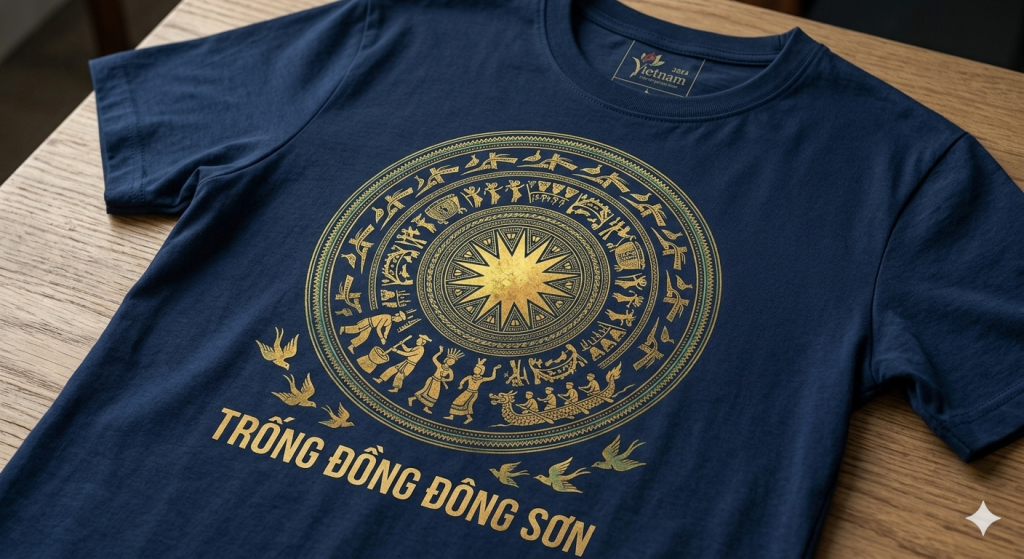
DONG SON DRUM
🥁 The Dong Son drum is not an artifact — it is a voice. A voice that has spoken across 2,500 years, telling us who the Vietnamese were, what they valued, and how they lived. “Dong Son Drum” celebrates Vietnam’s most iconic archaeological treasure — the bronze drums that represent the peak of ancient Vietnamese civilization and the pride of a continuous culture stretching back to the dawn of history.
The first Dong Son drums were discovered in 1924 along the Ma River in Thanh Hóa province, near the village of Đông Sơn — giving the culture its name. Since then, over 200 drums have been found across Vietnam, China, and Southeast Asia — evidence of the drum’s importance as a cultural export and a symbol of power. The drums date from 600 BCE to 200 CE — a period when Vietnam’s ancestors were organizing into sophisticated societies, developing bronze casting, and trading across vast networks.
This design incorporates drum motifs in abstract: concentric circles referencing the drum’s tympanum, radiating lines suggesting sound waves, geometric patterns evoking the drums’ intricate ornamentation.
The surface of Dong Son drums is densely decorated with scenes of daily life: warriors in feather headdresses wielding spears; farmers pounding rice in mortars; lovers in long boats with crescent prows; birds with outstretched wings; deer leaping; frogs encircling the rim. These images provide a window into a vanished world — where bronze was sacred, drums were royal, and art was inseparable from life.
“Dong Son Drum” weaves these ancient motifs into contemporary design: feather headdresses become decorative borders; long boats become flowing lines; leaping deer become repeated patterns. The past is not imitated — it is reinterpreted for modern eyes.
Feather Warriors
Chiến binh lông chimRice Pounding
Giã gạoLong Boats
Thuyền dàiFlying Birds
Chim bayFrogs
Nháy vòngProducing Dong Son drums required extraordinary technical skill. The drums were cast using the lost-wax method — creating a wax model, encasing it in clay, melting away the wax, pouring molten bronze into the hollow mold. The largest drums weigh over 70 kilograms and required over 2,000 degrees Celsius to melt the copper, tin, and lead alloys. This was not primitive craftsmanship — it was sophisticated engineering, as impressive as any technology of its era.
This design incorporates metallic tones — bronzes, coppers, golds — reflecting the drums’ material splendor. The patterns suggest alloy fluidity, casting complexity, and the heat required to transform raw ore into cultural masterpiece.
Dong Son drums were not merely musical instruments. They were symbols of chieftain power — displayed during ceremonies, buried with elites, traded as diplomatic gifts. The drum’s sound summoned communities for rituals, celebrated victories, mourned deaths. Owning a drum demonstrated wealth, influence, and divine favor.
“Dong Son Drum” honors this symbolic power through central, dominant design elements — the drum motif placed prominently, radiating authority, demanding attention. The star-like patterns echo the drums’ tympanum decorations — connecting ancient symbolism to contemporary national identity.
2,500 Years
Timeless heritage
Bronze Artistry
Daily life in metal
Lost-Wax Casting
Ancient mastery
Symbol of Power
Chieftain authority
Dong Son drums have been found across Southeast Asia — from Indonesia to Thailand, from Laos to southern China — suggesting that Vietnam’s ancient civilization was not isolated but connected, influential, and admired. The drum was Vietnam’s first cultural export, spreading Đông Sơn aesthetics and technology across the region.
This design incorporates world-map motifs — subtly, honoring the drums’ reach while celebrating Vietnamese origins. The outward- radiating lines suggest influence extending far beyond contemporary borders.
🇻🇳 DONG SON EDITION — BRONZE CULTURE COLLECTION 🇻🇳
Trống đồng Đông Sơn — Tiếng nói ngàn năm của dân tộc.
