Post
Sacred Fatherland
May
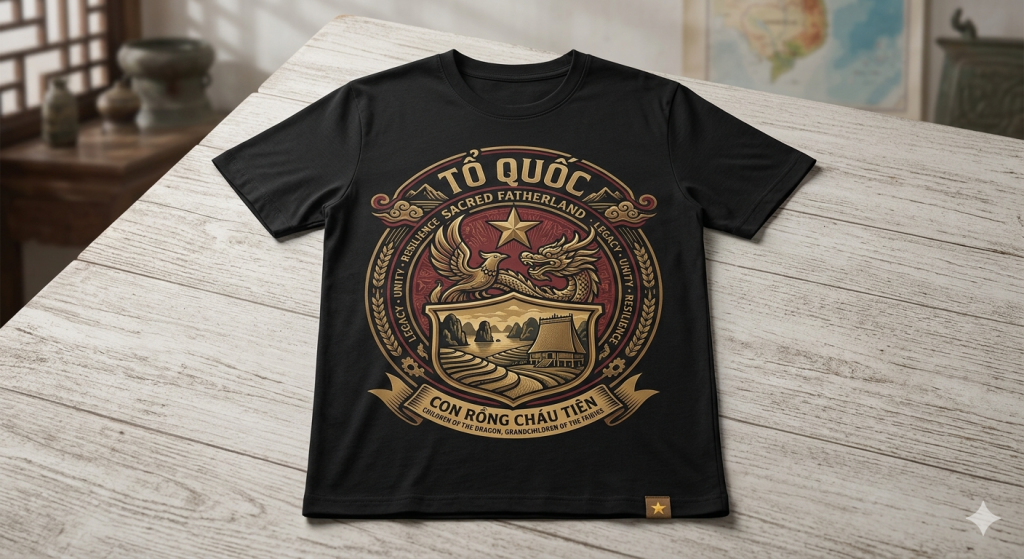
SACRED FATHERLAND
🙏 Vietnam is not simply a country on a map. It is an altar — where every grain of rice is an offering, every village gate a temple, every mother a goddess. “Sacred Fatherland” captures the profound spirituality that permeates Vietnamese life: the reverence for ancestors, the devotion to the homeland, and the belief that the land itself is holy.
Walk into any Vietnamese home, and you will find it: the ancestral altar. Often placed in the most honored position, it holds photographs of departed loved ones, burning incense sticks, fresh fruits, and flowers. Every morning and evening, family members pause before the altar to bow, to remember, to give thanks.
This is not ancestor worship in the Western sense. It is reverence — a recognition that those who came before are not gone but transformed. Their spirits watch over the living. Their sacrifices nourish the present. And their hopes extend into the future. “Sacred Fatherland” is inspired by this altar: the deep reds of lacquered wood, the gold of Buddha statues, the white of incense smoke rising to heaven.
Across Vietnam, sacred sites dot the landscape — from the Perfume Pagoda in the north to the Lady of the Realm shrine in the south. Bà Đen (Black Lady) Mountain in Tây Ninh, Yên Tử Mountain in Quảng Ninh, the Temple of Literature in Hanoi, the Thiên Mụ Pagoda in Huế. Each site draws pilgrims seeking blessings, healing, or simply a moment of peace.
“Sacred Fatherland” incorporates architectural motifs from these holy places: the curved roofs resembling flying dragons, the lotus symbols representing purity, the calligraphic strokes of Buddhist and Confucian teachings. The design invites wearers to carry a piece of these sanctuaries wherever they go.
Perfume Pagoda
Hương Tích
Black Lady Mt
Bà Đen
Temple of Lit.
Văn Miếu
Thiên Mụ
Huế
In Vietnam, even agriculture is sacred. The rice field is a temple; the farmer, a priest. The lunar calendar guides planting and harvest, with rituals at each stage to honor the Rice Goddess (Nữ thần Lúa). Villages hold festivals to pray for good weather and abundant crops. A single grain of rice is never wasted, because it contains the labor of ancestors and the blessings of the earth.
The patterns in “Sacred Fatherland” echo rice terraces — layered, curved, ascending. These motifs remind wearers that the sacred is not separate from daily life. It lives in the food we eat, the soil beneath our feet, the water that flows through our rivers.
Of all Vietnam’s spiritual traditions, ancestor veneration (thờ cúng tổ tiên) is the most universal, spanning Buddhist, Confucian, Taoist, and even Christian Vietnamese families. The belief is simple: death does not sever relationships. The dead remain part of the family, offering guidance and protection. In return, the living maintain the altar, offer food and incense, and ensure the ancestors’ names are remembered.
On holidays like Tết (Lunar New Year) and the Hung Kings’ Commemoration Day, families gather at ancestral altars, sharing meals and stories, keeping the connection alive. “Sacred Fatherland” honors this unbroken chain linking the living to the dead, the present to the past, the individual to the nation.
Ancestral Reverence
Honoring those before us
Sacred Sites
Pilgrimage & prayer
Holy Rice
Blessings of the earth
Eternal Flame
Love that never dies
When a Vietnamese person lights incense before the ancestral altar, they are not merely performing a ritual. They are communicating across time and space, saying: “We remember. We are grateful. We will continue.” The smoke of incense carries prayers upward; the glow of candles keeps darkness at bay.
“Sacred Fatherland” incorporates glowing, luminous elements — soft halos around central motifs, radiating lines like incense trails. These visual cues evoke the quiet, powerful experience of standing before an altar, connected to something vast and eternal. Wearing this design means carrying that altar with you — a portable sacred space, a reminder of who you are and to whom you belong.
🇻🇳 SACRED EDITION — ALTAR OF THE NATION COLLECTION 🇻🇳
Vietnam is not just a country. It is a prayer. It is an altar. It is sacred.
